
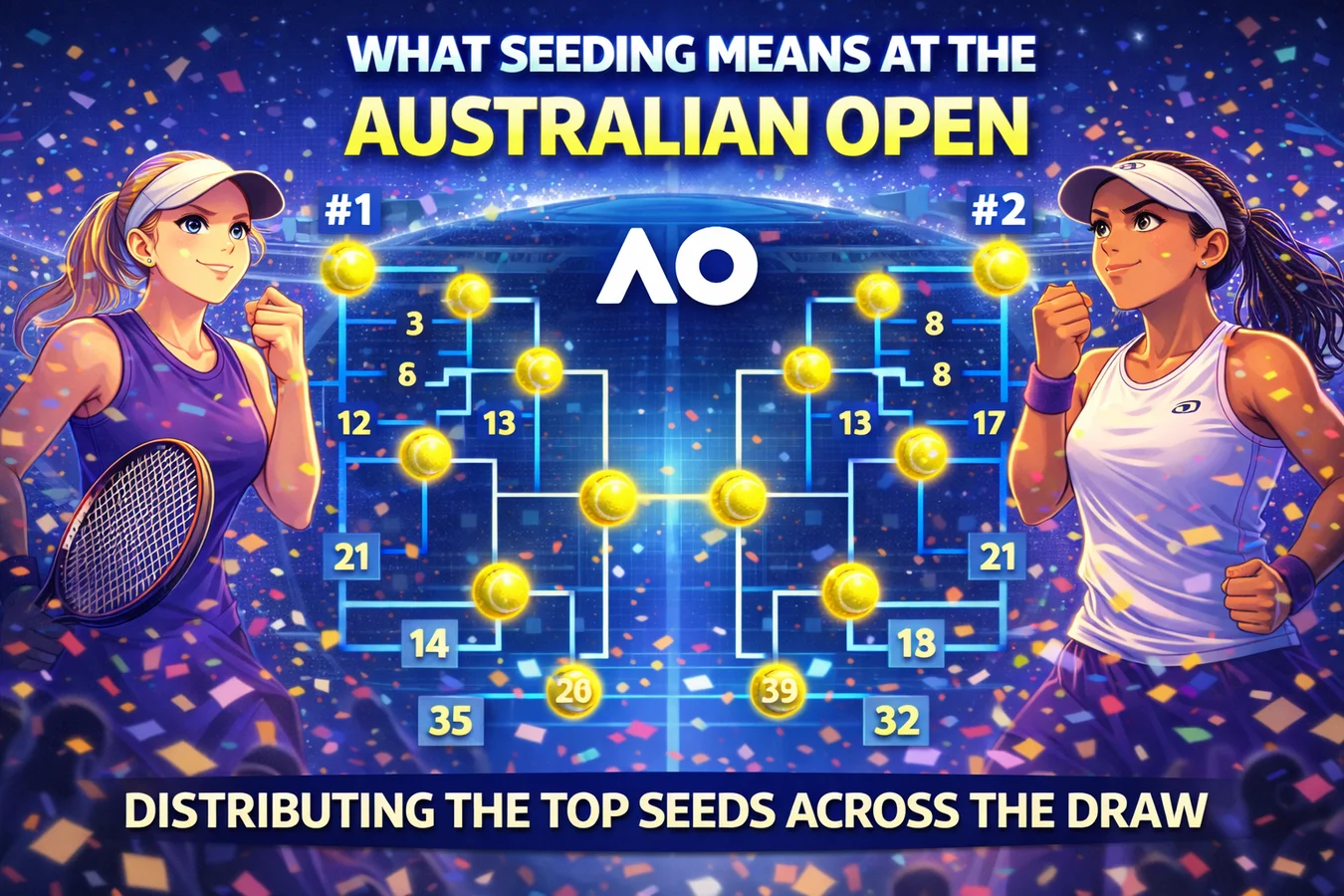
What seeding means at the Australian Open
The women’s singles seeds at the Australian Open are designed to keep the highest-ranked players apart in the early rounds. In a 128-player Grand Slam draw, the top 32 seeds are positioned so they cannot face each other in round one, and the very top seeds are protected from meeting until the later stages.
Seeding does not decide who wins — it decides the draw’s structure, ensuring the top-ranked contenders are distributed across the bracket rather than stacked in one section.
What the Australian Open uses to decide seeds
For the Australian Open, the seed list is based on WTA rankings, using a ranking snapshot close to the start of the tournament (seeding uses a later ranking date than the initial entry cutoff). In other words, the entry list is one thing, but the seeding order comes from the rankings used for the draw ceremony, so late changes in ranking can impact who lands inside the Top 32.
That’s why the seed list is effectively the tournament’s “ranking truth” at draw time — and why fans often see small differences between early entry lists and the final seed order.
Link to hub
For the full Australian Open 2026 women’s entry list (including direct acceptances, wildcards, and updates), see our main hub page:
Australian Open 2026 Women’s Entry List
Australian Open 2026 women’s seeds (1–32)
Below are the seeded players for Australian Open 2026 women’s singles, as listed on tennis-wta.com:
Top 8 seeds (the headline contenders)
- Aryna Sabalenka
- Iga Swiatek
- Coco Gauff
- Amanda Anisimova
- Elena Rybakina
- Jessica Pegula
- Madison Keys
- Jasmine Paolini
These eight are placed so that none can meet another Top 8 seed until at least the quarter-finals, which is why they dominate most “projected path” discussions the moment the bracket lands.
As you can see, Amanda Anisimova is seeded No. 4. That seeding reflects the official ranking list used at draw time — even if live rankings later show her moving above Coco Gauff.
Seeds 9–16 (danger zone for the elite)
- Mirra Andreeva
- Ekaterina Alexandrova
- Belinda Bencic
- Clara Tauson
- Linda Noskova
- Elina Svitolina
- Emma Navarro
- Naomi Osaka
This group matters because it’s where the draw can start to turn vicious early. Seeds 9–16 can be placed into the same quarters as the Top 8, meaning a favourite can draw a high-quality opponent by the fourth round, long before the tournament settles.
Seeds 17–24 (floaters capable of breaking sections)
- Liudmila Samsonova
- Victoria Mboko
- Karolina Muchova
- Elise Mertens
- Diana Shnaider
- Leylah Fernandez
- Jelena Ostapenko
- Qinwen Zheng
These are the names that often shape the second week without being tipped as obvious champions. If any of them catch form early, they can flip a quarter wide open — and they’re exactly the kind of opponents seeded players want to avoid in the first few rounds.
Seeds 25–32 (the “no freebies” line)
- Paula Badosa
- Marta Kostyuk
- Dayana Yastremska
- Sofia Kenin
- Emma Raducanu
- Veronika Kudermetova
- McCartney Kessler
- Maya Joint
From here down, you’re into the territory where the seed label protects you from playing another seed in round one — but not from playing an unseeded player who is returning from injury, under-ranked, or simply a nightmare match-up.
How seeded players are placed in the draw
Once the Top 32 seeds are confirmed, the Australian Open draw places them in fixed “zones” of the bracket so the biggest collisions are delayed:
- Seed 1 and Seed 2 are placed at opposite ends of the draw, so they can only meet in the final.
- Seeds 3–4 are placed in opposite halves, so they can only meet Seed 1 or Seed 2 in the semi-finals.
- Seeds 5–8 are then spread out so they can’t meet a Top 4 seed until the quarter-finals.
After that, seeds 9–32 are distributed across the remaining sections so that each portion of the bracket has a balanced mix of seeded players. That’s why the draw can look “unfair” on paper even when the placement method is standard — the system ensures separation among seeds, not equal difficulty.
Why the seed list matters when you read the entry list
The entry list tells you who is in the tournament. The seeds tell you who the tournament is built around.
Once the bracket is released, the seed lines help you instantly understand:
- which quarter is likely to be the most crowded with contenders,
- where a big name could face a tough opponent early,
- and which sections have a clearer runway into week two.
If you’re following Australian Open 2026 daily, the seed list is the easiest way to make sense of why certain third-round matches feel like semi-finals.