
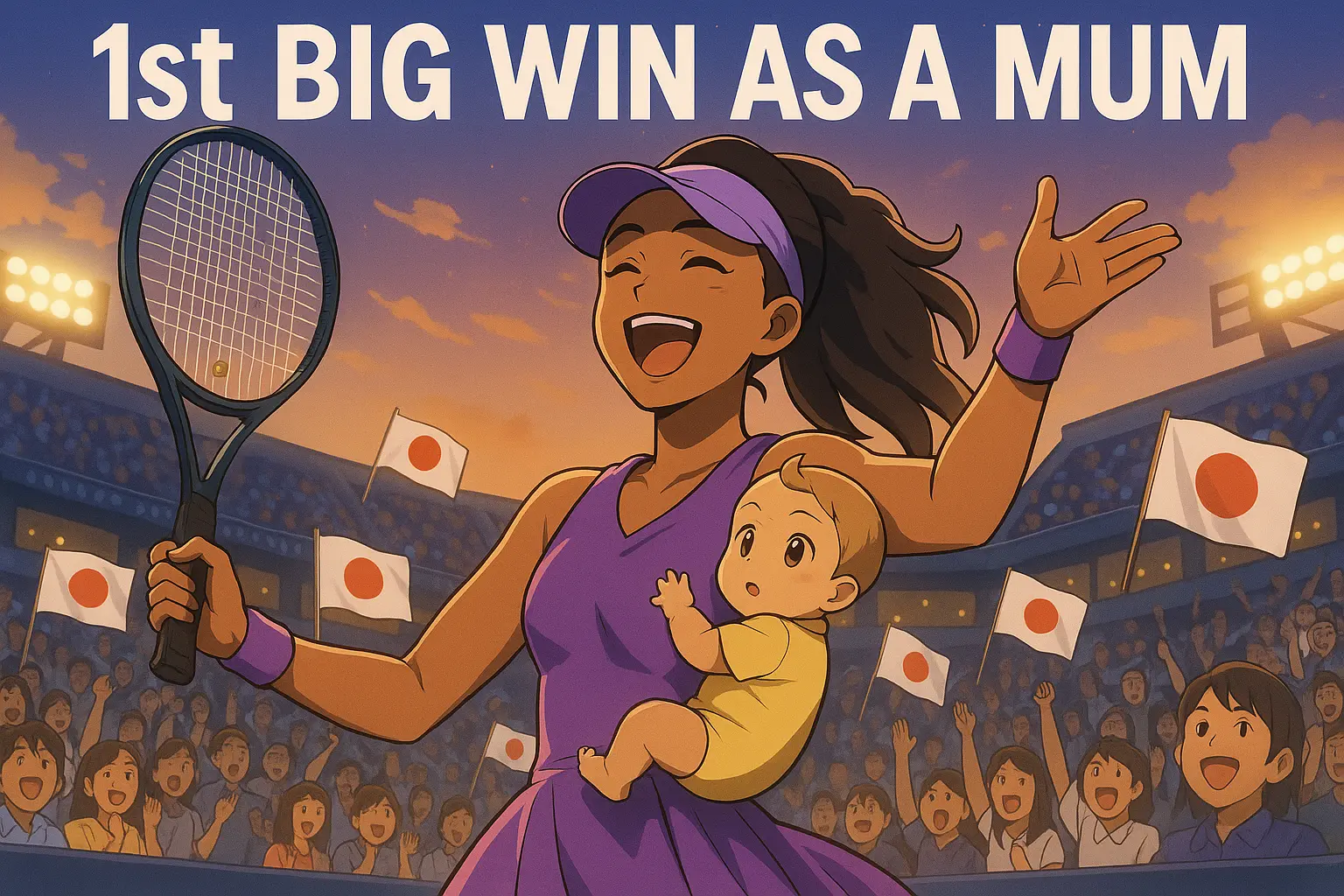
Naomi Osaka didn’t come back to make up the numbers. She came back to test a simple, ruthless question: Can my A-game still bend the sport?By the end of 2025, the answer wasn’t a throwback fairytale, but something more interesting: a season in three acts where she rebuilt her base, re-learned the grind, and reminded everyone at the US Open that her ceiling is still one of the scariest in tennis.
Hard Courts: Home, But Not Yet Comfortable
The year opens in Melbourne with a very Osaka sort of statement: straight into the deep end.
She starts the Australian Open ranked No.51, draws Caroline Garcia in round one, and wins it like an old rival, not a comeback guest: 6–3 3–6 6–3, behind 78% points won on first serve and a solid 52.5% on second. Match two, she flips a bad start into a good result: 1–6 6–1 6–3 over Karolina Muchova, showing the first real sign that her problem-solving instincts haven’t rusted.
Then the early-season fragility hits. She retires a set down in a tight third-round tiebreak against Belinda Bencic and has to live with the most uncomfortable feeling in a comeback: not “I’m not good enough,” but “my body might not let me find out.”
Indian Wells is flat – 4-6 4-6 and a straight-sets loss to Camila Osorio – so it’s really Miami that drags the season into shape. From there, you can see the bones of the year:
- Miami R16: battles through Yuliia Starodubtseva and Hailey Baptiste, also beats Liudmila Samsonova 6–2 6–4 with a huge performance – 79.3% first-serve points, 75% on second – before falling in three to Jasmine Paolini.
- The pattern is set: when she lands first serves and keeps the double faults low, she’s still a top-10 level hard-courter. When the rhythm goes, the margins narrow quickly.
The hard courts early on are less about dominance and more about re-entry: can she handle three-hour battles again? Can she back up tight wins? The answer turns from “sometimes” in March to “absolutely” by late August.
Clay: The Conscious Rebuild
Osaka didn’t treat clay as a nuisance in 2025; she treated it like homework.
The results aren’t headline-grabbing, but the choices are. After an opening-round loss in Madrid to Lucia Bronzetti, she drops down to Saint-Malo 125 – the move of a player thinking long-term, not chasing appearance fees.
There, she grinds:
- Wins five straight matches, many of them messy, and takes the title 6-1 7-5 over Kaja Juvan in the final.
- Across the week, her first serve holds up nicely (often around 80% points won behind the first serve), but the real value is repetition: point construction, sliding, trusting heavy cross-court patterns instead of just ripping flat.
Rome builds on that work:
- Wins over Sara Errani, Viktorija Golubic, and Marie Bouzkova, all in three-set battles except the opener.
- Falls in a brutal third-set tiebreak to Peyton Stearns in the R16, despite 76.8% points won on first serve.
Then Roland Garros: straight into a seeded threat, Paula Badosa. Osaka snatches the first set in a tiebreak but fades 6–7(1) 6–1 6–4. It’s not a moral victory – she’s had plenty of those – but in the context of the clay stretch, it fits: still short of being a second-week clay player again, but no longer the automatic upset alert she once was in Paris.
Clay in 2025 is not about trophies at the top tier. It’s about Osaka deliberately rebuilding a surface she used to tolerate. She leaves Europe with a 125 title, a Rome R16, and a loss at Roland Garros that hurts for the right reasons: because it was close enough to matter.
Grass: Edges and Echoes
The grass season feels like déjà vu – promise, edges, then someone else walking off with the handshake.
- In Berlin, she takes a wild-card and loses in three to Liudmila Samsonova after winning the first set. Again, strong first-serve numbers (over 78% first-serve points won), but not enough in the long exchanges.
- In Bad Homburg, she squeezes out two tiebreaks against Olga Danilovic, then loses a straight-sets baseline war to Emma Navarro 6-4 6-4.
At Wimbledon, the draw is gentle early:
- Beats Talia Gibson and Katerina Siniakova in straight sets.
- Then runs into Anastasia Pavlyuchenkova and loses 3–6 6–4 6–4, despite a decent 57% first-serve in and solid numbers behind it.
The grass numbers say what the eye test confirms:
Osaka’s weapons absolutely translate – the serve, the first strike, the ability to shorten points – but her grass instincts still lag. She’s dangerous; she’s not yet inevitable.
After Wimbledon she is still where she was before the start of the AO25.
Spot No.51.
North American Hard Courts: The Old Power Roars Back
Then comes the real heartbeat of the season: North America.
In Washington, she looks rusty-sharp – the game is good, the stamina not quite there. Wins over Yulia Putintseva, then a flat 6-4 6-2 loss to Emma Raducanu.
It’s Montreal that turns her from interesting comeback into active threat:
- Beats local player Ariana Arseneault routinely, then takes out Samsonova, Ostapenko, Sevastova, Svitolina, and Tauson in a row.
- The win over Coco Gauff at the US Open will get the headlines later, but that Montreal run is the structural proof: Osaka can still string elite back-to-back wins at WTA 1000 level.
In the final, she goes up a set on Victoria Mboko before losing 2–6 6–4 6–1. That defeat becomes part of Mboko’s breakout mythology, but it says something about Osaka too: when the legs fade and the second serve loosens, she’s beatable again. This is not peak 2018 Osaka ignoring scoreboard pressure; this is 2025 Osaka, still re-building match fitness and emotional fuel.
Then New York.
The US Open is her single defining stretch of 2025:
- Beats Greet Minnen and Hailey Baptiste without fuss.
- Handles Daria Kasatkina in three, then detonates the tournament by destroying Coco Gauff 6–3 6–2, winning an absurd 93.8% of first-serve points and 77.3% on second.
- Backs that up with a straight-sets win over Karolina Muchova, then loses an absolute epic semi-final to Amanda Anisimova: 6–7(4) 7–6(3) 6–3.
That run answers the question that hovered over her all year:
Can she still boss a Slam hard-court draw?
Yes. Not for seven straight matches yet. But for six? Absolutely.
After that, the autumn swing feels like emotional aftershock. Early loss in Beijing to Aliaksandra Sasnovich. A gritty win 4-6 7-5 6-3 over Leylah Fernandez in Wuhan, followed immediately by a 7-6 (2) 6-3 loss to Linda Noskova. A home event in Osaka where she wins two matches, then withdraws before the quarter-final.
These are the marks of a player who pushed her body and her focus to peak in New York – and paid for it later.
Numbers, Patterns, Red Flags
A few stats carve out the shape of this season:
- First serve remains world-class
Across her big wins, she regularly pushes 70–80% points won on first serve. Against Gauff in New York, it’s a cartoonish 93.8%. When the first ball lands, she still controls matches. - Second serve is the truth serum
In wins, she tends to hover around or above 50% points won on second serve. In losses – especially deeper into draws – that number collapses into the 30s. The gap between A-game and under-pressure serve is still too big. - Tiebreaks and third sets matter
A lot of 2025 is decided in that thin band:
– Retires from a tight scenario vs Bencic in Melbourne
– Edged out by Paolini (Miami), Stearns (Rome), Samsonova/Mboko in key matches
– Survives thriller after thriller at the US Open before finally running out of room vs Anisimova - Surface identity is evolving
Hard courts are still home; clay is now a working project rather than a graveyard; grass is functional but not yet weaponised.
And zooming out, you get the real unique arc of her year: 2025 is the season where Osaka stops being a “comeback story” and re-enters the draw as a problem again. Not always solved. Not always efficient. But absolutely relevant.
Naomi Osaka Assessment
Naomi Osaka’s 2025 season isn’t a perfect redemption story. It’s something better: evidence.
Evidence that:
- Her serve is still one of the defining shots in the sport.
- She can handle the physical and mental weight of deep Slam runs again.
- She can build a clay résumé if she keeps doing the unglamorous work.
- The locker room now has to factor her in not as a nostalgia act, but as a live threat at any hard-court event she enters.
There are gaps: early losses, a couple of worrying retirements/withdrawals, and a clay and grass record that still lags behind her peak. But that’s exactly why this isn’t being dressed up as a flawless comeback. It’s a year of solid, repeatable foundations rather than pure highlight-reel mythology.
Final Verdict
This isn’t an A season because the whole year didn’t match New York’s level. It is an A- because she turned a question – “Is Naomi really back?” – into a much sharper one: “How much higher can she go in 2026?”
GPA 3.6
Oh, and before you go: our money’s on the Top 10 next year — she’s sitting at No.16 right now.
Related WTA Articles You Might Enjoy
Coco Gauff Smashes an Unwanted WTA Record as Double-Fault Woes Hit New Heights in 2025
Naomi Osaka battles past Leylah Fernandez in three-set thriller