
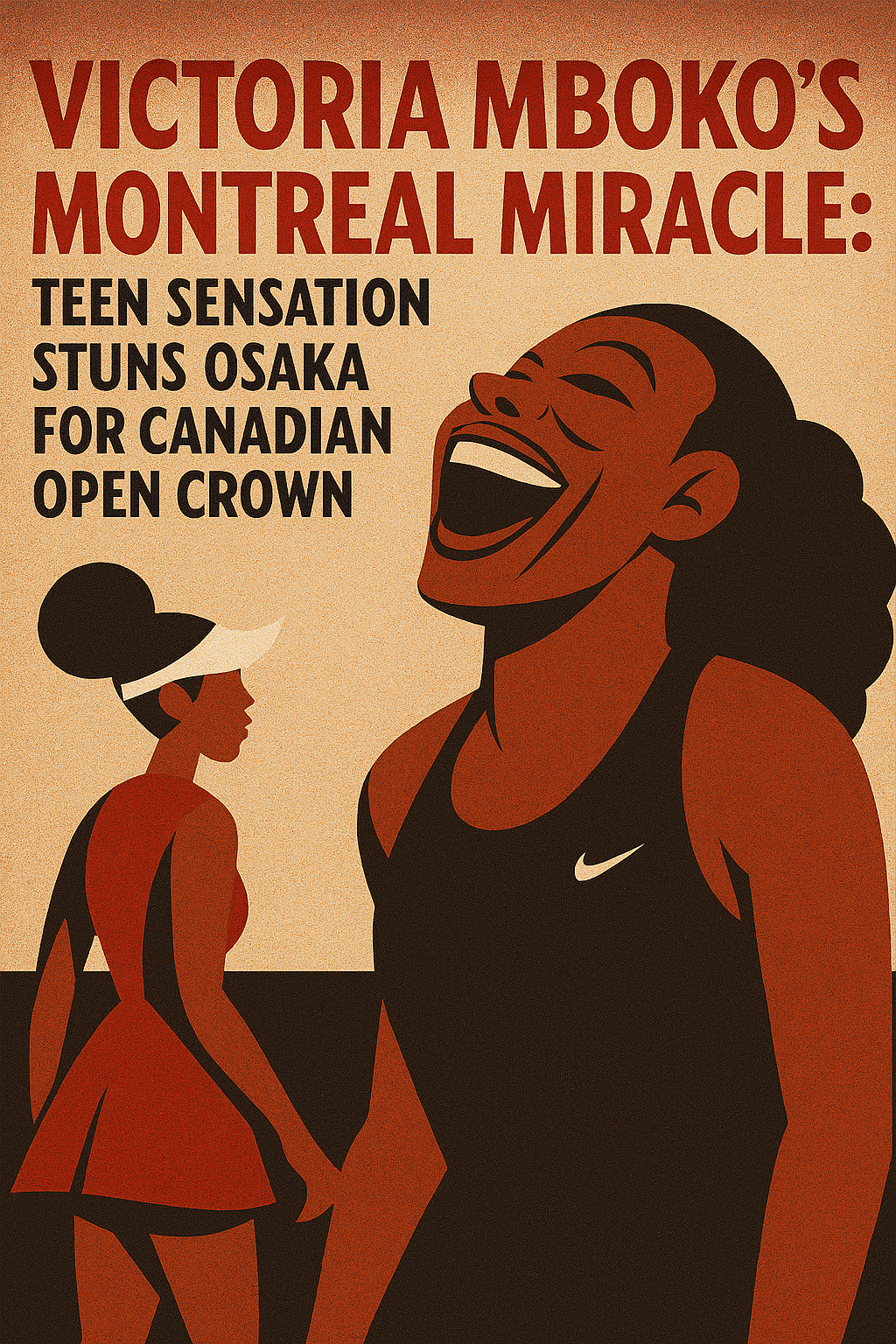
In January, Victoria Mboko was grinding through W35s in the Caribbean, ranked in the 300s and still more promise than product. By late October, she was lifting a WTA 1000 trophy in Montreal, owning wins over Coco Gauff, Elena Rybakina, Naomi Osaka and Leylah Fernandez, and sitting on the edge of the top 20.
This assessment looks only at her singles season – and what a season it was. Victoria Mboko is the first player we’ve rated with an A since we started our Top 40 season assessment series.
From 35Ks to the WTA Map
The opening month was pure acceleration. Mboko tore through back-to-back W35 events in Martinique and Guadeloupe, going 10–0 in matches and 20–1 in sets. The numbers were ridiculous: first-serve points routinely above 75%, bagels everywhere, and barely an hour on court most days. It wasn’t about opposition quality yet; it was about learning how to win week after week.
She immediately levelled up in Rome (USA) at W75 level, running the table again. Five straight wins, another title, and a serving pattern emerging: high first-serve percentage (often north of 65%) and a willingness to hit through second serves rather than roll them in. The double faults came with it, but so did scoreboard pressure.
By Manchester and Porto she’d made the “dominant favourite” role look routine. Three more titles, multiple weeks with nothing but green on the results sheet, and a ranking that rocketed from the 300s towards the top 160 in barely two months. The most impressive metric: in those early-season ITF runs she faced very few break points, and when she did, she saved an enormous share of them – often 70–100%. Big moments never felt big to her.
Miami was the first proper stress test. As a wildcard ranked outside the top 150, she outlasted Camila Osorio in nearly two and a half hours, then took Paula Badosa – a top-10 seed – to 7-6(3) in the third. Suddenly the futures bully looked like a tour-level problem.
Clay Education and Paris Arrival
Clay, inevitably, cooled the streak a touch. Saint-Malo and Parma showed the learning curve. She took good wins over players like Jil Teichmann, Nuria Parrizas Diaz, Xin Yu Wang and Irina-Camelia Begu, serving north of 70% first serves in several matches and still dictating with her forehand. But Mayar Sherif, one of the tour’s better clay specialists, exposed some movement and patience issues in the Parma final. The Canadian lost 6-4 6-4.
Rome qualifying was a key checkpoint. Mboko beat Cristina Bucsa and Kamilla Rakhimova to reach the main draw, then handled the occasion calmly against Italian wildcard Arianna Zucchini. Against Coco Gauff in the second round she actually grabbed the first set 6-3 before the American reset and ran away with it 6-2 6-1. Still: a teenager going toe-to-toe with a reigning Slam champion on clay is a data point you circled.
Roland Garros confirmed it. She navigated three rounds of qualifying without dropping a set, then beat Lulu Sun and Eva Lys in the main draw to reach the last 32 in her first Paris appearance. Qinwen Zheng ended the run 6-3 6-4, but the pattern held: Mboko’s serve plus first-strike forehand travelled to clay better than expected, even if her defence and shot selection sometimes lagged behind the pace she generated.
Grass Lessons and a Soft Landing at Wimbledon
Grass was a mixed classroom. In Wimbledon qualifying she came back from a set down against Nao Hibino, rolled Valentina Ryser, then lost a tight three-setter to Priscilla Hon. A lucky-loser spot into the main draw was the reward, and she grabbed it ruthlessly – straight-sets over seeded Magdalena Frech, then a competitive loss to Hailey Baptiste 7-6(6) 6-3.
The grass numbers were telling: first-serve percentages often up near 70–75%, but a rising double-fault rate as she chased free points. When the first serve landed, she looked like a natural on the surface. When it didn’t, she gave away too many cheap games.
Still, by mid-summer she had done four distinct things: dominated ITF, proven she belonged on WTA draws, impress at majors, and shown she could win on every surface.
Montreal: The Week the Tour Had to Learn Her Name
Then came Montreal, and everything changed.
Arriving as a wildcard ranked outside the top 80, Victoria Mboko played one of the most outrageous breakout weeks of the decade. She beat Kimberly Birrell 7-5 6-3, Sofia Kenin 6-2 6-3, Marie Bouzkova 1-6 6-3 6-0 and Jessica Bouzas Maneiro 6-4 6-2 to reach the quarter-finals, surviving several three-set brawls and holding her nerve in tight service games despite double-fault spikes. That alone would’ve been a dream run.
Instead, she had gone bigger one round earlier already. She dismantled world No.1 Coco Gauff 6-1, 6-4 with a fearless mix of heavy cross-court forehands, flat backhands taken early, and a serve that landed 79% of first deliveries and won nearly two-thirds of them. She then came back from a set down to beat Elena Rybakina 1-6 7-5 7-6(4) in a 2:46 thriller, before flipping the script on Naomi Osaka in the final – losing the first set 2-6, then storming back 6-4, 6-1 to lift her first WTA 1000 trophy.
That week showed the full Mboko package:
- Serve as a weapon, not just a start of the point – when her first serve percentage sat around 60–65%, top-10 players struggled to get into rallies. Against Rybakina it was exceptional. 72%.
- Return aggression – she regularly stepped inside the baseline on second serves, especially to the backhand, and took time away from even elite servers.
- Competitive resilience – she went 6–1 in the deciding set of the final (including Hong Kong later), and several of those came from a set down.
By the end of Montreal, she had leapt from ITF curiosity to WTA 1000 champion and top-25 threat in barely seven months.
Slam Reality Checks and Asian Swing Consolidation
The flip side of a meteoric rise is that tour veterans start circling your name. At the US Open, Barbora Krejcikova dissected Mboko’s patterns, dragging her into longer exchanges and punishing the second serve. Straight sets, an early 6-3 6-2 exit, and a reminder that the majors have their own learning curve.
The Asian swing brought more of that reality – tight losses to Anastasia Potapova in Beijing, Ekaterina Alexandrova in Wuhan and Dayana Yastremska in Ningbo. The stats showed a clear theme: her first serve remained elite in volume and impact, but double-faults and patchy second-serve numbers (often sub-40% won) gave experienced opponents too many cheap looks.
Then she steadied again. In Tokyo, she beat Bianca Andreescu and Eva Lys before a creditable 6-3 7-6(4) loss to the WTA-Finals-chasing Rybakina. In Hong Kong, she went full closer:
- Came back from a set down three times (Gibson, Eala, Fernandez)
- Logged a retirement win over Anna Kalinskaya while already in control
- And closed out Cristina Bucsa in a three-set final to take the Hong Kong title.
By year’s end, Mboko had:
- Run through six ITF titles and two WTA titles (Montreal 1000, Hong Kong 250)
- Reached the third round at Roland Garros and main draw at Wimbledon
- Beaten multiple top-10 players, including Gauff, Rybakina, Osaka, Fernandez and Potapova
- Climbed from around No.333 to inside the top 25, finishing 2025 at roughly No.18 in the world!
Victoria Mboko Assessment
Technically, Mboko’s season is built around three pillars:
- Serve + Forehand Axis
- First-serve percentage often between 65–75%, with some ITF weeks even higher.
- When the first ball lands, she wins like a top-10 player; the DR (dominance ratio) in early-season events and in Montreal sits well above 1.3, which is elite territory.
- The weakness is clear: double-fault spikes in high-pressure games, and a second serve that can sit up and invite punishment.
- Big-Match Temperament
- She played a mountain of deciding sets and usually emerged on top, especially in finals: Porto, Montreal and Hong Kong all featured comebacks or tight finishes.
- Against elite opposition at Slams, the emotional load still shows. The Swiatek/Zheng/Gauff tier handled her better over five-to-seven match structures than they did in a one-off 1000. That’s normal for a first full season.
- Tactical Growth Across Surfaces
- On hard courts she already plays with a clear identity: step in, take time away, build the point around the forehand, and use the backhand as a directional tool.
- On clay she’s learning to build points more patiently; Parma and Roland Garros were promising but highlighted the need for better shot tolerance.
- On grass her serve plays up beautifully, but return positioning and transition instincts will decide whether she becomes a serious Wimbledon danger or just “dangerous”.
What elevates the whole package is the trajectory. She didn’t just have one hot month; she layered evidence neatly: ITF dominance, WTA qualifying success, Slam breakthroughs, 1000 title, and a second-half tour-level title to prove Montreal wasn’t a one-off.
Final Verdict A
For a player who started the year lugging her bags around 35Ks and ended it as a WTA 1000 champion, top-25 fixture, and one of the most feared young hitters on tour, the grade almost writes itself.
Letter Grade: A
GPA 4.0
A few things stop this from being A+ territory: Slam results that lag behind her 1000 and 250 success, a still-fragile second serve under pressure, and some late-season physical wear that turned close matches into losses.
But as 2025 closes, the picture is crystal: Victoria Mboko has moved from “remember the name” to “plan around her in the draw”. If she tightens the second serve, adds a touch more tactical patience, and keeps this competitive edge, 2026 won’t be about breakthroughs. It will be about whether the rest of the locker room can catch up. Canada better be ready.
Related WTA Articles You Might Enjoy
Victoria Mboko Says “There’s So Much More to Come” as She Reveals Her Off-Court Love for Bruno Mars
Victoria Mboko Stuns Rybakina in Montreal Epic: From Double Fault Despair to Tiebreak Glory