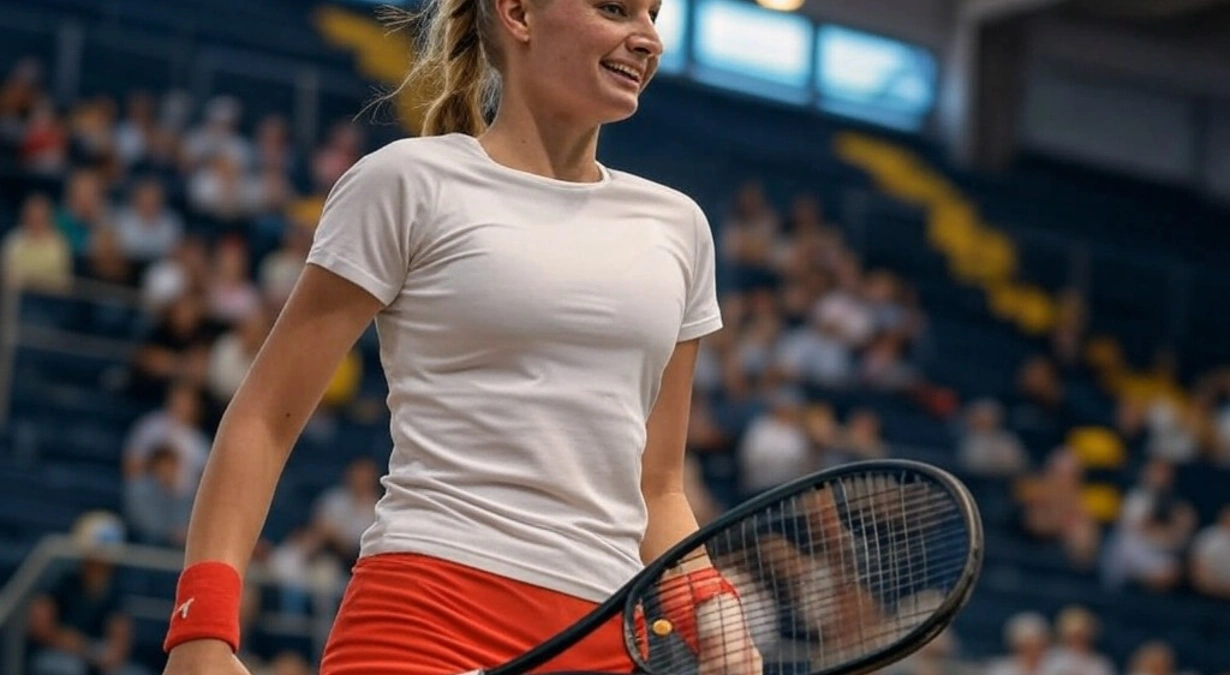
If there was one player the seeds didn’t want anywhere near their quarter in 2025, it was Dayana Yastremska. She didn’t win a title, didn’t crack the Top 20, and still managed to leave a trail of wreckage through draws on three surfaces.
She started the season as the No.34 seed who could blow hot and cold within a single afternoon. She ended it hovering around the Top 30 having beaten Coco Gauff twice, smacked Emma Navarro out of a WTA 1000, and turned more than one “routine” day at the office into a full-scale emergency for the favorites. What she didn’t do was string it all together for a full week often enough.
This was her year of being the danger rather than the destination.
Hard Start: Hobart Frustrations and a Quiet Melbourne Ceiling
Brisbane was a false start: a straight loss to Potapova, the kind of match that looked more like a post-offseason scrimmage than a launch.
Hobart gave us the first template of her season. As top seed, she beat Volynets and Ann Li as expected, then lost to McCartney Kessler in the quarters 7-5 6-4— exactly the sort of result that keeps a coach awake at night. The ball-striking was there; the ranking protection was not.
At the Australian Open, she did the basics correctly. Wins over Mayar Sherif and Danka Kovinic put her into the third round without fuss. Then Elena Rybakina came through and shut the door in straight sets 6-3 6-4. The gap was obvious: Yastremska could bully the tier below; against a proper Slam contender, she still looked more like a disruptor than a peer.
Linz: First Real Charge, No Trophy
By the time she landed in Linz, her ranking had dipped to 72. The response was classic Yastremska: not gentle rebuilding, but a full-blooded shove.
She beat Lucia Bronzetti, then Antonia Ruzic, and then came the statement wins — straight-sets victories over Sakkari 7-5 6-0 and Tauson 6-1 6-4, both the sort of matches where her first-strike tennis actually held together point after point.
The final against Alexandrova was a step too far and she lost 6-2 3-6 7-5. The Russian absorbed the pace, redirected it, and denied Yastremska the title that could’ve rewritten the narrative of her early season. Still, Linz got her moving. The ranking climbed, the locker room took renewed notice.
Gulf and Sunshine Swing: Picking Fights With the Very Top
Doha brought a flat loss to Peyton Stearns, but Dubai reminded everyone why she’s considered one of the WTA’s most combustible threats. She beat Magda Linette and Potapova back-to-back, both solid wins against experienced opponents.
Then she ran into a familiar brick wall: Iga Swiatek. Losing 7-5 6-0 to the world No.2 in round of 16 was no shame, but it fit an emerging pattern — Yastremska could throw punches at the established elite, not necessarily finish the job.
Indian Wells was cleaner: wins over Yue Yuan and Ons Jabeur, followed again by Swiatek shutting her down in the third round on 6-0 6-2. Miami flipped the script the wrong way, with a first-round loss to Belinda Bencic that never really caught fire.
By March, the story was solidifying: she was good enough to keep getting shots at the best. Not yet good enough to consistently take them.
Clay: Work in Progress With One Paris Spark
Stuttgart was a mini-grind through qualifying — Konjuh, then Seidel — before Ostapenko hit straight through her.
Madrid saw her beat Francesca Jones and then lose to Coco Gauff. Rome was an early exit to Potapova. The clay numbers weren’t terrible; they were forgettable — second rounds, third rounds, nothing that changed her tier.
Roland Garros, at least, gave her a proper result. She handled wildcard Destanee Aiava, then pulled off an excellent 7-5 7-5 win over Diana Shnaider, one of the tour’s more awkward lefty problems. Liudmila Samsonova stopped her in the third round with a 6-2 6-3 win, but Paris at least put a tick in the “dangerous on dirt” column that has been under review for years.
Grass: Nottingham, Eastbourne, and the Night She Took Out Gauff
If there’s one stretch Yastremska will replay with both pride and regret, it’s June.
Nottingham was the grass version of Linz: a sustained, confident run without the final touch. She beat Danilovic, Ruzic, Leylah Fernandez 6-3 7-6(6), and Linette 6-4 6-4 in succession, showing that her flatter ball and return aggression sit comfortably on the surface. Then McCartney Kessler, again, beat her in the final, snatching away what looked like her most winnable trophy of the year.
Eastbourne extended the momentum. She beat Linette again, then took care of Jones before Alexandra Eala stopped her in the quarterfinals. Not a bad loss; not a signature week either.
Wimbledon, though, delivered the headline.
First round: Yastremska d. Coco Gauff 7-6(3) 6-1, the second seed and reigning US Open champion. It was the upset that lit up the draw sheet and reminded everyone why nobody wants her as an early-round opponent. She backed it up with a workmanlike win over Zakharova before Jessica Bouzas Maneiro took her out in the third round, a result that felt more like a missed opportunity than a fair ceiling.
On grass, her reputation changed. She went from streaky hitter to fully established threat.
Hamburg and the European Postscript
After Wimbledon, she dipped back onto clay in Hamburg as the second seed and played like it for most of the week: Niemeier, Parry, and Galfi all dispatched in straight sets. The semifinal 6-1 7-6(5) loss to Lois Boisson stung — not a disaster, but another moment where a draw had opened nicely and she didn’t quite force it shut.
North American Summer: Navarro, Gauff, and a Hard Ceiling
Montreal was her best WTA 1000 showing of the season. She beat Camila Osorio, then took out Emma Navarro 7-5 6-4 — a proper scalp given Navarro’s Top-10 status and rising reputation as a hard-court problem.
Rybakina stopped her in the last sixteen, as Rybakina tends to do when she finds her serve.
Cincinnati was more of the same: a comfortable win over Viktoriya Tomova, then a walkover loss to Gauff. She’d shown she could knock off the American on grass; on hard courts, the power-to-stability ratio still tilted Coco’s way.
The US Open was a letdown — a first-round exit to Pavlyuchenkova that halted what had been a steady summer climb.
Asian Swing: Familiar Foes, Familiar Margins
Beijing brought another defeat to Bouzas Maneiro, turning that particular match-up into a small but irritating subplot. Wuhan added Siegemund to the list of awkward losses albeit after retirement.
Ningbo offered one last flicker: a solid win over Victoria Mboko, then another defeat to Rybakina, who continued to act as a personal ceiling on Yastremska’s ambitions.
Tokyo finished things off in flat fashion — a first-round defeat to Diana Shnaider, a name she should now know carries real danger.
Dayana Yastremska Assessment
Strip the calendar down to bullet points and her 2025 looks deceptively simple:
- Two WTA finals (Linz, Nottingham), a handful of semifinals.
- Wins over Gauff (on Wimbledon grass), Navarro (on hard), Sakkari, Tauson, Linette, Fernandez, Shnaider.
- Regular third-round appearances at majors and 1000s.
- A year-end ranking inside the Top 30 after starting in the low 30s and dipping into the 70s mid-season.
The numbers say she’s a solid top-30 professional with spikes. The eye test says something more volatile. Yastremska’s 2025 was built on shock value — knocking out bigger names, blowing up nice clean draws — but too often without the steady backend of titles or back-to-back deep runs at the very top tier.
The trends are clear:
- Against the true elite (Swiatek, Rybakina, Gauff on hard), she nearly always came second.
- Against the mid-tier and younger climbers, she was as likely to turn a quarterfinal into a statement as she was to let it slip.
- Her game is still pure first-strike aggression, but the shot tolerance and point construction improved just enough to make her more than a one-note hitter.
It was not a breakout year. It was a consolidation year with teeth — one that re-established her as a seeded threat rather than a ranking curiosity.
Final Verdict: B
A season that never quite found its trophy but repeatedly found its moment. Yastremska proved she can still terrify seeds, push herself into finals, and live in the Top 30 on merit, not memory.
The missing pieces are obvious: one proper title, one Slam second week, one full-throttle run at a 1000 without a familiar ceiling shutting her down.
GPA: 3.0
For now, 2025 goes down as the year she stopped being a wildcard storyline and became what the locker room already knew she was — a hazard written into every draw sheet in thick black ink.
Related WTA Articles You Might Enjoy
Dayana Yastremska Outduels Danish Clara Tauson to Book Linz Final Spot
Alexandrova 2025: The Year Ekaterina Finally Stopped Knocking and Walked In